
For teachers and schools
You teach Hindi. Kiki makes sure they practise it between classes.
In a class of twenty, each child gets about two minutes of speaking a week. Kiki gives every child ten minutes of speaking a day, on your class's topics.
What every Hindi teacher knows
They understand, but they won't answer.
Ask a question and you get a nod, or a reply in English.
Class time can't give everyone a turn.
One teacher, twenty children, one lesson. Most of them speak for a minute or two.
Sunday's lesson fades by next week.
Without practice in between, each class starts by going over the last one.
What your class gets
Your class, your topics, your families. Kiki is the speaking practice they do at home.
A link for your class
We give you a class link and a school code. Families sign up with it, and their children join your class.
Topics from your curriculum
We set up your class's topics with you, from what you teach. Your students practise them with Kiki, out loud.
Your class dashboard
Who practised this week, the class's most common slip with your children's own sentences to teach from, and each child's Speaking Index level. Listen to their recordings and read the corrections Kiki made.
Parents see the practice too
After each conversation, the family can play it back: everything their child said, in their child's own voice. Parents see the practice happening between your classes.
Teaching for CBSE? Listening and speaking are part of the internal assessment in Hindi. Kiki gives every child daily speaking practice for it.
What you see before class
Two minutes on a Sunday evening tells you who to call on, what to teach, and whom to praise.
For the whole class
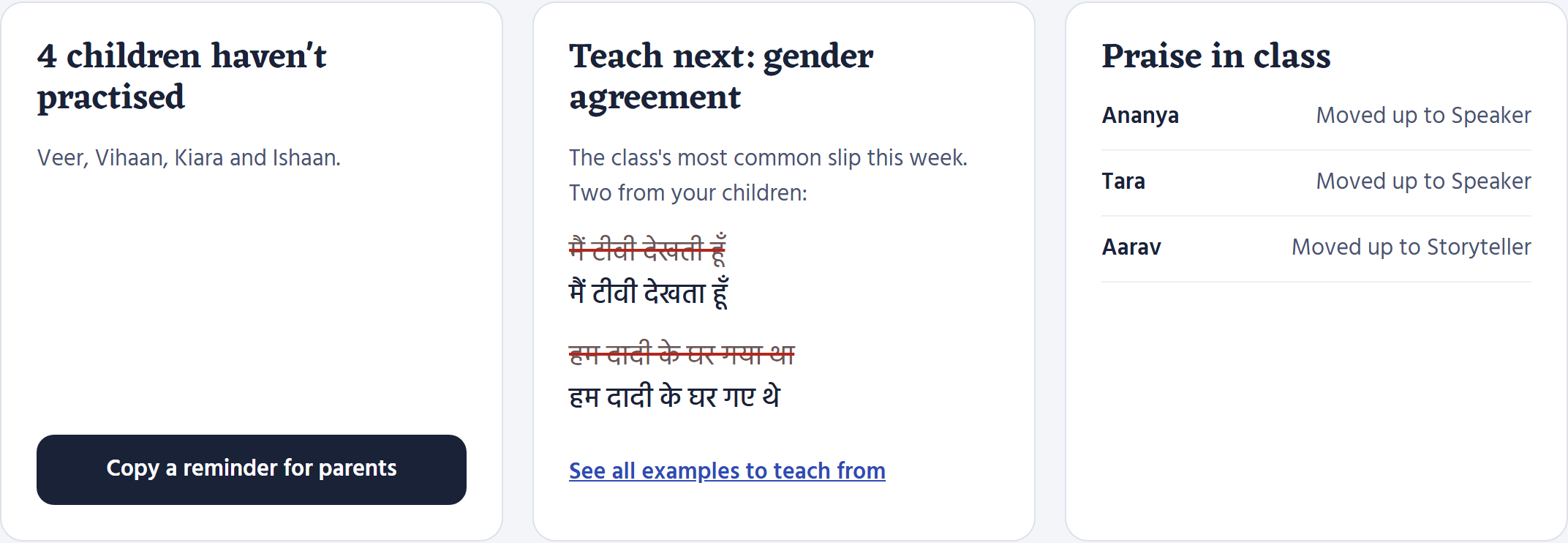
Who hasn't practised, with a reminder you can paste into the class group.
The slip most of the class is making this week, in their own words.
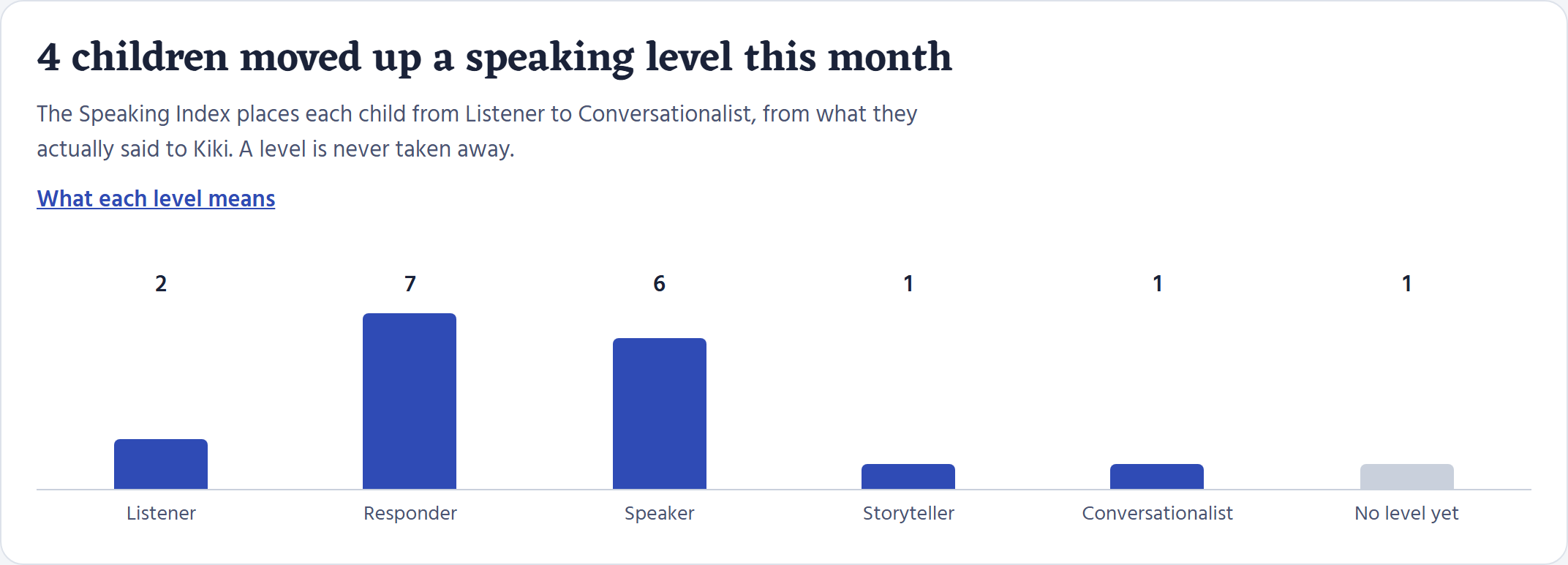
Where every child sits on the Speaking Index, and who moved up.
Tap an image to see it full size.
For one child
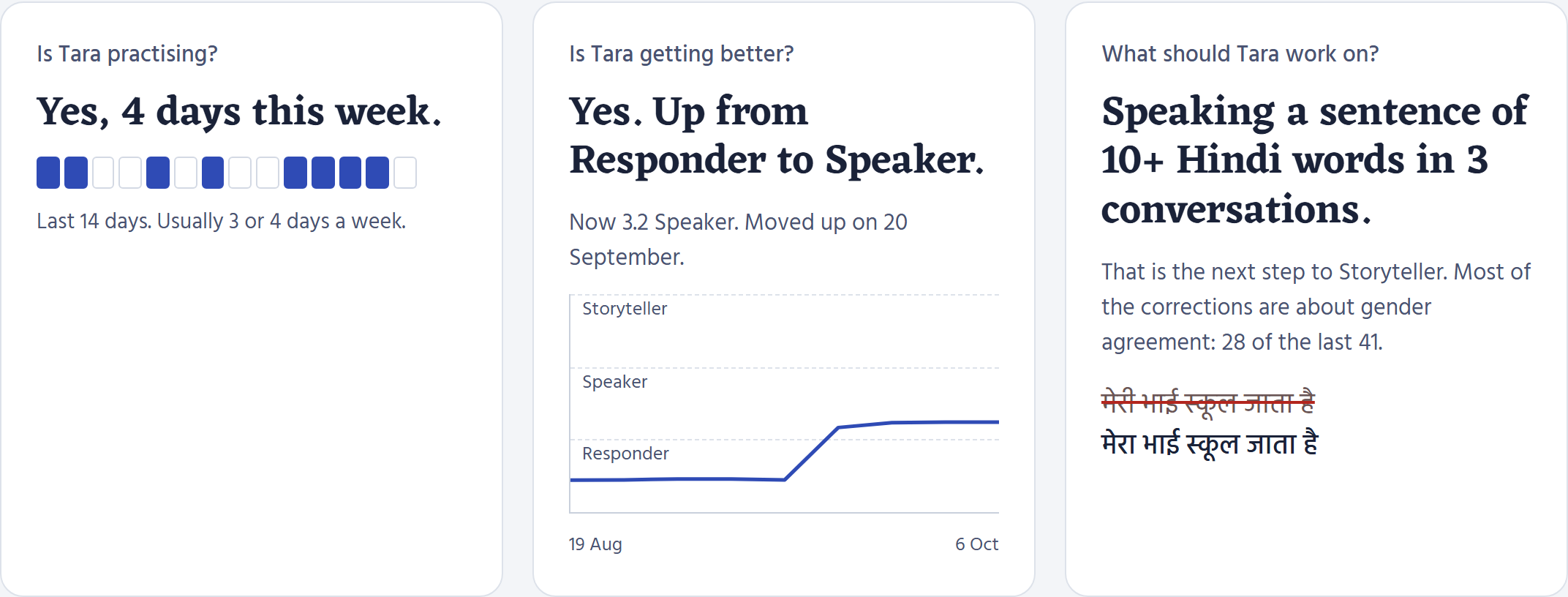
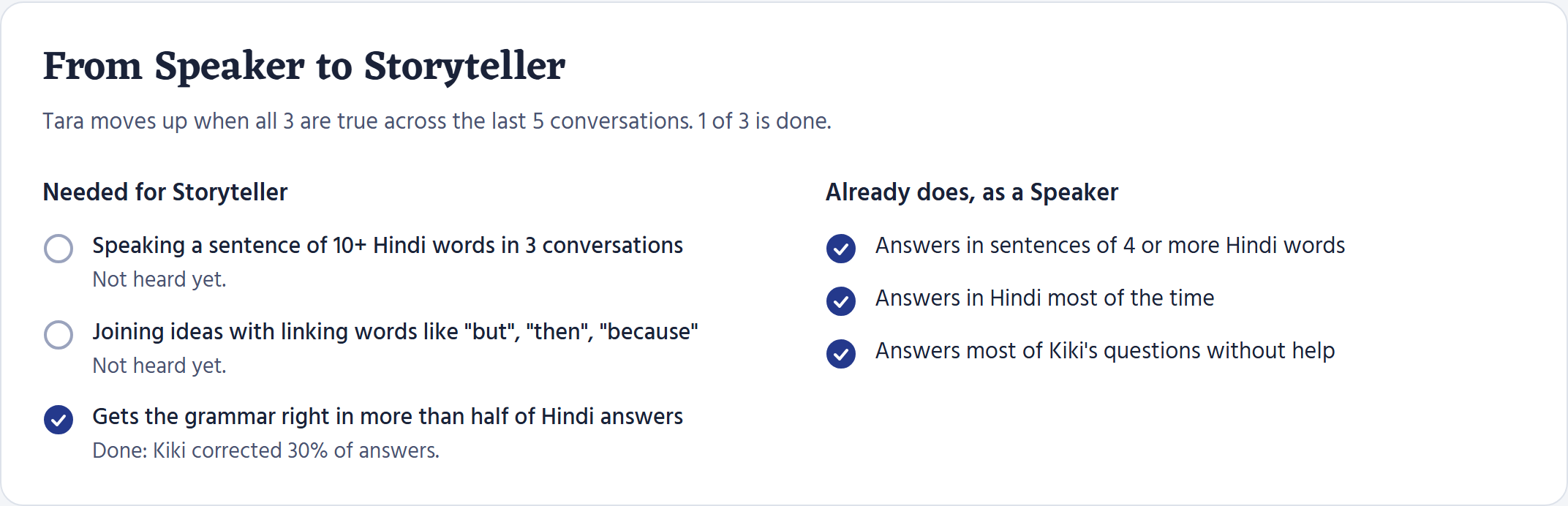
Is she practising, is she getting better, and what exactly is the next step. Every gate is a thing she said or has not said yet, not a grade.
A sample class. Names and sentences are illustrative; the numbers are computed by the same code a real class sees.
How the Speaking Index measures speaking
A child's level is computed from what they actually said to Kiki, by rules that are public. No model grades the child, and nothing a teacher cannot check against the recording goes into it.
Five levels
- 1
Listener: understands familiar Hindi and answers in English, with silence, or by picking an offered option.
- 2
Responder: answers a familiar question with a Hindi word or short phrase, without a model to copy.
- 3
Speaker: makes simple original sentences of four to six words, mostly Hindi, with slips that do not block meaning. Can say what, not yet why.
- 4
Storyteller: joins ideas with words like "because", "but" and "then", tells what happened, and holds a topic across turns.
- 5
Conversationalist: holds a five-minute unscripted conversation about their own day and opinions, with subordinate clauses and mostly correct grammar.
The line most of a class needs to cross is 2 to 3: from answering in Hindi to saying something of their own in it.
What is counted
| Component | Weight | What it is |
|---|---|---|
| Output | 25 | The share of answers in Hindi or mixed Hindi; English words inside a Hindi sentence count as speaking, not as a fault. |
| Complexity | 25 | The typical length of the child's own answers, in Hindi words. |
| Accuracy | 20 | How often Kiki had to correct the grammar of a Hindi answer. |
| Independence | 15 | Answers the child gave alone, not echoed from Kiki or a parent. |
| Vocabulary | 15 | How many different Hindi words the child used, and how often they reached for English where a Hindi word was available. |
How a level is decided
- Every count is per turn. A long conversation cannot inflate a child.
- A level is a claim about a child, so it is decided over a window of the last five conversations, never on one. Each level has gates: for example a Speaker's typical answer is four or more Hindi words and at least 60 percent of answers are in Hindi. A child is at the highest level whose gates all hold.
- A level is never taken away. A run of short question-and-answer topics is not evidence the child lost Hindi.
- A conversation the child did not follow is left out of the index rather than scored low. That would measure the topic, not the child.
What it is built on
The levels follow performance descriptors in the tradition of the ACTFL proficiency guidelines, adapted for children who grow up hearing Hindi at home, whose comprehension runs far ahead of their speech and who mix English into Hindi as a matter of course. Code mixing is graded, not penalised, because it is evidence of production. The framework and the scale are published under an open licence.
The gates are set from our own transcripts and are being calibrated against teachers' ratings. Until that is done, we say a child moved up a level on our index, not that they reached a level of any external standard. If you teach Hindi, you can help calibrate it: rate ten short recordings on a one-page sheet.
What Kiki doesn't do
Kiki is not a class, and not a replacement for one. It leaves these to you:
- Reading
- Writing
- Teaching grammar
- Festivals
- Friends
- A real teacher
Kiki does one thing: speaking practice. It works best alongside a teacher.
From a class that uses it
From a school that uses Kiki with its Hindi classes.
We have used Hindi Tutor in our classrooms with students ranging from ages 4 to 16 and have been impressed by the level of engagement it generates. The interactive format encourages students to practice speaking Hindi without fear of being judged, making language learning both enjoyable and confidence-building.
We have also assigned it as homework and found that completion rates were noticeably higher than with traditional assignments. Students genuinely enjoy using the platform, which makes language practice feel less like work and more like play.
 Archana Athalye, Founder
Kulturekool NJ
How it starts
-
1
We set up your class
We set up your class link and your topics with you.
-
2
You share the link
You share the link with your families.
-
3
You see who is practising
You see who is practising in your class view.
Talk to us
Tell us a little about your class.